# Test an Ethereum network in your browser
[Read this guide on KeySigner](https://keysigner.io/integrations/guides/test-an-ethereum-network-in-your-browser/)
Add a local Ethereum test network in Chrome or Firefox, review the network details in KeySigner, and switch between saved networks without signing a transaction.
## Before you start
**KeySigner computer tools, Anvil and Python 3**
- Use Chrome 111 or later and load the unpacked development extension in a separate browser profile.
- Use Firefox 128 or later and load the temporary development add-on in a separate browser profile.
- [Check the Google Chrome version](https://keysigner.io/integrations/setup-requirements/#check-versions-google-chrome)
- [Check the Firefox version](https://keysigner.io/integrations/setup-requirements/#check-versions-firefox)
## Data and access
- **Shared or checked**. The requesting site supplies the proposed chain ID and RPC URL. KeySigner checks the endpoint’s chain ID before saving the network.
- **Check separately**. Saving or switching a network does not grant account access. A signature or transfer still needs its own approved request.
## Watch the network review
See the Chromium development extension review a request from the local test page, add the Anvil network and switch back.
[Watch the video](https://keysigner.io/integrations/guides/test-an-ethereum-network-in-your-browser/network-walkthrough.mp4)
### Video transcript
- The local test page finds KeySigner. Choose Add local network.
- Check the site, chain ID 31338 and RPC address. Choose Add network.
- The test page reports Active chain: 0x7a6a.
- Switch back to the original chain. The page reports 0x1.
## 1. Start a local test network
Run Anvil on your computer with chain ID 31338. Leave it running while you test. Load the KeySigner development extension in a fresh browser profile using the matching instructions below.
~~~
anvil --host 127.0.0.1 --port 8545 --chain-id 31338 --silent
~~~
**Check.** Anvil reports chain ID 31338 and the browser’s extension view lists KeySigner.
### Load the extension for your browser
- **[Chrome setup](https://keysigner.io/integrations/guides/approve-an-ethereum-request-in-chrome/#step-1)**. Choose Load unpacked in the extension manager and select the extension folder.
- **[Firefox setup](https://keysigner.io/integrations/guides/approve-an-ethereum-request-in-firefox/#step-1)**. Choose Load Temporary Add-on in about:debugging and select manifest.json. Load the add-on again after restarting Firefox.
## 2. Open a local test page
Download network-test.html or save the source below with that filename in an empty folder. Open a second terminal in that folder and run python3 -m http.server 8000 --bind 127.0.0.1. In your test browser, open http://127.0.0.1:8000/network-test.html.
[Download example source](https://keysigner.io/integrations/guides/test-an-ethereum-network-in-your-browser/network-test.html.txt)
Save the file as `network-test.html`.
~~~
KeySigner local network test
~~~
**Check.** The local page displays “KeySigner found.”
## 3. Review the network before adding it
Choose Add local network. In the KeySigner browser prompt, check the requesting site (127.0.0.1:8000), Local KeySigner Test, chain ID 31338 and RPC address http://127.0.0.1:8545. Try Decline first. Repeat the request and choose Add network.
**Check.** Decline leaves the active chain unchanged. Add network changes the active chain to 31338, displayed as 0x7a6a.
## 4. Test a mismatch and switch back
Choose Try the wrong chain ID to request 31339 from the same RPC endpoint. Then choose Switch between saved networks to return to the original chain. Choose it again to switch back to the local chain. Close the test browser and stop both local servers when finished.
**Check.** The mismatch says the RPC reports 31338 and leaves the active chain unchanged. The switch button returns to the original chain, then back to 0x7a6a.
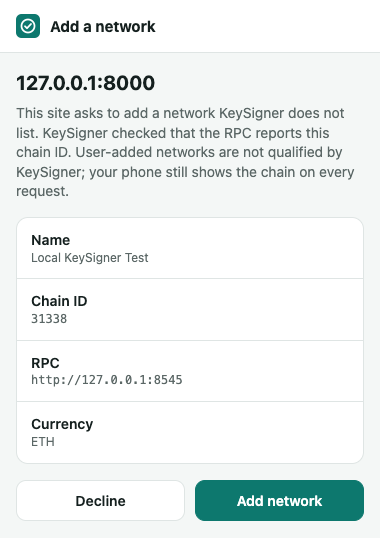
The network review in the Chrome development extension, using the local test page above.
## Check your result
After you add the local network, the page reports Active chain: 0x7a6a (31338). The mismatched request displays an error and leaves 0x7a6a active. Switching between the saved networks changes the active chain without opening an add-network prompt.
### What we tested
**Tested on November 17, 2026.** Chromium and Firefox used the development extension, the local bridge and a local Anvil chain. Both declined a request, rejected a mismatched chain ID, added the matching chain and switched between saved networks.
[How to verify your setup](https://keysigner.io/integrations/verify-a-setup/)
## If you get stuck
### The test page can't add the network
Check that the development extension and computer tools are installed and that Anvil is listening on 127.0.0.1:8545 with chain ID 31338. If the test network was previously saved, start with a fresh profile to see the add-network prompt again. KeySigner requires HTTPS for remote RPC endpoints and allows HTTP on localhost or 127.0.0.1.
## Tools in this guide
- [Google Chrome](https://keysigner.io/integrations/google-chrome/)
- [Load a development extension in Chrome](https://developer.chrome.com/docs/extensions/get-started/tutorial/hello-world#load-unpacked)
- [Setup requirements](https://keysigner.io/integrations/setup-requirements/#google-chrome)
- [Firefox](https://keysigner.io/integrations/firefox/)
- [Load a temporary add-on in Firefox](https://extensionworkshop.com/documentation/develop/temporary-installation-in-firefox/)
- [Setup requirements](https://keysigner.io/integrations/setup-requirements/#firefox)
- [Ethereum](https://keysigner.io/integrations/ethereum/)
- [Review transaction fields, signatures and fees](https://ethereum.org/developers/docs/transactions/)
## Setup instructions
- [Run a local test network with Anvil](https://getfoundry.sh/anvil/reference/)
- [Read the add-network request specification](https://eips.ethereum.org/EIPS/eip-3085)
- [Read the switch-network request specification](https://eips.ethereum.org/EIPS/eip-3326)
- [Retest a site connection after a change](https://keysigner.io/integrations/guides/retest-an-ethereum-site-connection/)
- [Connect KeySigner to an Alchemy test network](https://keysigner.io/integrations/guides/connect-keysigner-to-an-alchemy-test-network/)
- [Try the browser rehearsal](https://keysigner.io/integrations/rehearse-an-ethereum-network-request/)
[More guides for this task](https://keysigner.io/integrations/tasks/test-wallet-network/)